
SAN FRANCISCO, California, July 2026: Most engineering teams have black box testing somewhere in their process. They test APIs, validate user flows, and check that services respond correctly to defined inputs. What far fewer teams do is apply that same external-facing validation discipline to the boundaries between their own services. The result is a category of failure that gets discovered in production rather than in the pipeline.
The structural gap is straightforward once it's named. In a microservice architecture, each service is tested against its own specification. Unit tests verify internal logic. Integration tests confirm database interactions. The service looks healthy by every available metric. What those tests don't cover is how the service behaves when called by another service with inputs that diverge from documented assumptions. When that divergence happens, the failure surfaces at the boundary rather than inside either service, and neither team's test suite is designed to catch it.
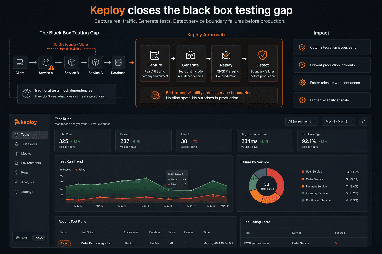
Keploy approaches this from a different direction. Rather than relying on developers to define what black box tests a boundary should pass, Keploy captures the actual traffic flowing between services in development and testing environments and converts those real interactions into repeatable black box test cases. The tests validate request structures, response schemas, status code behavior, and error handling based on what services actually exchange rather than what a specification says they should.
The Specification Drift Problem
Service specifications and the behavior of the services they describe tend to diverge over time. A response field gets renamed in a patch. An error code changes in a minor version update. A new required header gets added without a corresponding documentation update. Each of these changes is small on its own. None of them would raise concern during a standard code review. Together, across months of parallel development on multiple services, they create a growing gap between what consuming services expect and what producing services actually deliver.
Black box testing at the boundary level catches this drift as it accumulates rather than after it causes an incident. When Keploy replays captured traffic against a service and responses diverge from the recorded baseline, the failure appears in the CI run rather than in a production alert. The consuming service doesn't need to be involved in the test. The check is simply confirming that the producing service's external behavior hasn't changed in ways that its callers depend on.
Traffic-based black box validation derives its test cases from observed behavior. No developer needs to write a specification for it to work, and no specification needs to stay current for it to remain accurate. The recorded traffic is the specification.
The teams closing this gap most effectively are those that stopped treating service boundaries as a deployment concern and started treating them as a testing concern. A boundary either behaves consistently or it doesn't. Black box testing at that layer is how teams find out which one is true before their users do.