
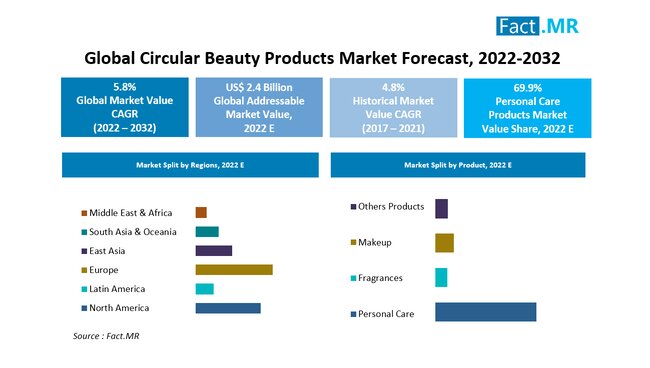
The market for circular beauty products is currently worth US$ 2.4 billion and is expected to grow at a CAGR of 5.8% from 2022 to 2032.
The market is expanding as a result of factors such shifting lifestyle trends, a growing demand for eco-friendly beauty products, eco-friendly packaging options, products free of animal testing, and chemical-free goods.
Rapidly-changing fashion trends and government enforcements to produce zero waste beauty products in a few countries are anticipated to draw people’s attention to circular beauty products, resulting in Increased Demand for Circular Beauty Products in the near future.
According to the United Nations, one-third of the total food production procured for human consumption is wasted or lost from the primary source. It is high time beauty product manufacturers cater to this issue by investing in developing beauty products from food waste ingredients.
For more insights into the Market, Get A Sample of this Report!
https://www.factmr.com/connectus/sample?flag=S&rep_id=7528
Skincare and haircare formulation manufacturers have been utilizing food ingredients, especially superfoods from food waste, which is a more eco-friendly and new development. However, food waste ingredients are not a niche idea from smaller beauty ingredients companies but an important step towards the sustainable future of beauty products.
- French cosmetic giant L’Oréal announced an investment fund for improvising innovations in the circular economy on the occasion of Earth Day, on April 22.
Key Takeaways from Market Study
- By product, the personal care segment is projected to provide an absolute $ opportunity of US$ 1.2 billion over the forecast period (2022-2032).
- Among the sales channels, online sales are anticipated to expand around 2.2X in market value by 2032 and create an absolute $ opportunity of US$ 1.2 billion by 2032.
- Female consumers are set to account for an absolute $ opportunity of US$ 1.1 Billion.
- Europe is expected to hold around 33.5% of the global circular beauty products market share by 2032.
- North America is predicted to provide an absolute dollar opportunity of US$ 483 million by 2032-end.
Winning Strategy
A key strategy for participants in the circular beauty products market has been to salvage waste from food and beverage companies that are intended to go to landfills. In addition, companies are using F&B byproducts that they reclaim and optimizing their utilization in the formulation of skin care products.
Companies are also focusing on manufacturing facilities for capacity expansion for bringing sustainable products to the masses and are investing in the research and development of innovative products, customized to fulfill the demand of niche consumer segments.
Manufacturers should increase their production, and, as a result, aim to offer innovative products that are tailored to the customized needs of consumers, with a focus on sustainability. Additionally, collaboration with retail channels should remain a vital strategy for manufacturers of circular beauty products, as they would become aware of the needs of consumers, and, in turn, develop application-specific products, catering to diverse customers across geographies.
Augustinus Bader, BYBI, Caudalie, Chanel, Circumference Inc., Earth Harbor, Fruu, Mark & Spensors, Monta Monta, Rabot 1745, Superzero, The Body Shop, Three Ships are key manufacturers of circular beauty products.
- Aquafaba (chickpea salt water, usually discarded) has the same properties as egg white and can be used as a replacement for hair care products. Lush has launched a vegan protein shampoo made with Aquafaba, touting its protein and saponin properties to protect and strengthen fine hair.
- British brand UpCircleBeauty launched an oil, scrub, and soap bar based on used coffee waste and chai spice granules.
- Food supplier Daylesford Organic launched a bitter orange hand balm containing cold-pressed citrus aurantium from Seville orange peels.
- Fruu combines locally-produced series of small batches of processed fruit waste bi-product beauty, such as natural lip balm, to create biodegradable beauty products and sustainable formulations, which at the same time brings additional revenue for small fruit producers.
Key Segments Covered in Circular Beauty Products Industry Research
- by Product :
- Personal Care
- Body Care
- Skincare
- Haircare
- Fragrances
- Makeup
- Others Products
- by Consumer Orientation :
- Male Circular Beauty Products
- Female Circular Beauty Products
- by Sales Channel :
- Online Sales Channels
- Company Websites
- e-Commerce Platforms
- Offline Sales Channels
- Hypermarkets/Supermarkets
- Modern Trade Stores
- Brand Stores
- Beauty Salons
- Pharmacies
- by Region :
- North America
- Latin America
- Europe
- East Asia
- South Asia & Oceania
- Middle East & Africa
Get Full Access of the Complete Report:
https://www.factmr.com/checkout/7528
More Valuable Insights on Offer
Fact.MR, in its new offering, presents an unbiased analysis of the circular beauty products market, presenting historical market data (2017-2021) and forecast statistics for the period of 2022-2032.
The study reveals essential insights based on product (personal care (body care, haircare, skincare), fragrances, makeup, other products), consumer orientation (male, female), and sales channel (online sales channels (company websites, e-Commerce platforms), (offline sales channels (hypermarkets/supermarkets, modern trade stores, brand stores, beauty salons, pharmacies)), across six major regions of the world (North America, Latin America, Europe, East Asia, South Asia & Oceania, and the Middle East & Africa).